
Progress in synthesis of chiral amines
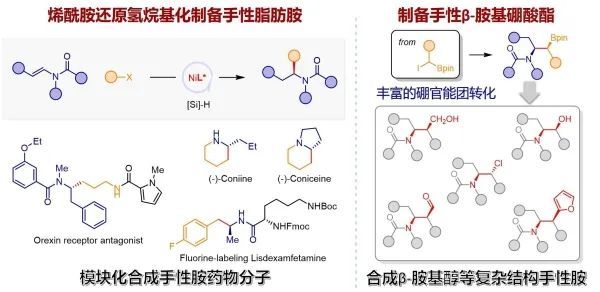
Recently, Fu Yao, Professor of Hefei National Research Center for micro scale material science and School of chemistry and materials science, University of science and technology of China, and Lu Xi, special associate researcher, made progress in the field of chiral amine synthesis, developed nickel hydrogen catalyzed asymmetric hydroalkylation of enamides, and realized the modular synthesis of chiral fatty amines under mild conditions. On February 26, relevant research results were published in nature · communication under the title of catalytic asymmetric reducing hydrogenation of enamides and enecarbamates to Chinese aliphatic amines.
Chiral amines are important chiral auxiliaries and key synthetic intermediates of pharmaceutical and natural products. Efficient and convenient synthesis of chiral amines is an important direction in organic synthetic chemistry. Conventional catalytic synthesis methods, such as imine / enamine hydrogenation, imine alkylation and olefin hydroamination, have substrate structure limitations in the synthesis of dialkyl substituted chiral fatty amines.
Researchers put forward the concept of "olefin reduction coupling", developed a cheap metal nickel catalytic system, used olefins instead of equivalent metal reagents to realize carbon carbon coupling under mild conditions, simplified synthesis steps, enriched substrate range Improve functional group compatibility (NAT. Commun. 2016,7, 11129; J. am. Chem. SOC. 2017139, 12632; J. am. Chem. SOC. 2020142, 214). Recently, researchers have made progress in the combination of saturated carbon couples to chiral amines, and successfully realized nickel hydrogen catalyzed asymmetric hydroalkylation of enamides. Stable and easily available enamides and alkyl halides are used as raw materials to prepare acyl protection with high enantioselectivity Chiral aliphatic amine compounds with mild reaction conditions and wide application range of substrates. The reaction can be applied to the efficient synthesis and modification of a variety of natural products and drug molecules. For example, the reaction can realize the efficient synthesis of physiologically active molecules or their isotopic markers such as alkaloid apigenine, ADHD drug rituximab and asthma drug carmoterol. In addition, the reaction between enamide and α- Asymmetric hydroalkylation of boric acid ester halides to prepare compounds with two chiral centers β- Amino borate. The new method will be helpful to the development of amine chiral molecules with complex structures.
This study shows a new strategy of nickel catalyzed saturated carbon coupling modular synthesis of chiral fatty amines, which provides a new method for the synthesis of drugs containing chiral amine structures, natural products and nitrogen-containing complex chiral molecules. It is a supplement and breakthrough to the structural limitations of conventional chiral amine synthesis strategies. Wang Jiawang, a doctoral student from the school of chemistry and materials science, University of science and technology of China, and Li Yan, a doctoral student from Hefei National Research Center for microscale material science, are the co first authors of the paper. The research work was supported by the National Natural Science Foundation of China, the Chinese Academy of Sciences and Anhui Key Laboratory of biomass clean energy.