
Amorphous forming ability of materials
Amorphous alloy (also known as metallic glass) has the characteristics of metal and glass, solid and liquid, showing excellent mechanical, physical and chemical properties, and has important applications in high-tech fields such as high-end equipment, energy and information. However, amorphous alloy is a typical multicomponent alloy material, and its element diversity and complexity make the on-demand design of high-performance amorphous alloy materials very challenging.
The difficulty of forming amorphous materials from an alloy under specific conditions is called amorphous forming ability (GFA). This index is also a key index limiting the engineering application of amorphous alloys. It is listed in the national key R & D plan "key scientific issues of transformative technology" With the support of key projects, Liu Yanhui and Wang Weihua research teams of Institute of physics of Chinese Academy of Sciences / Beijing National Research Center for condensed matter physics have realized the high-throughput and process R & D mode of new amorphous alloy materials on the basis of preliminary research.
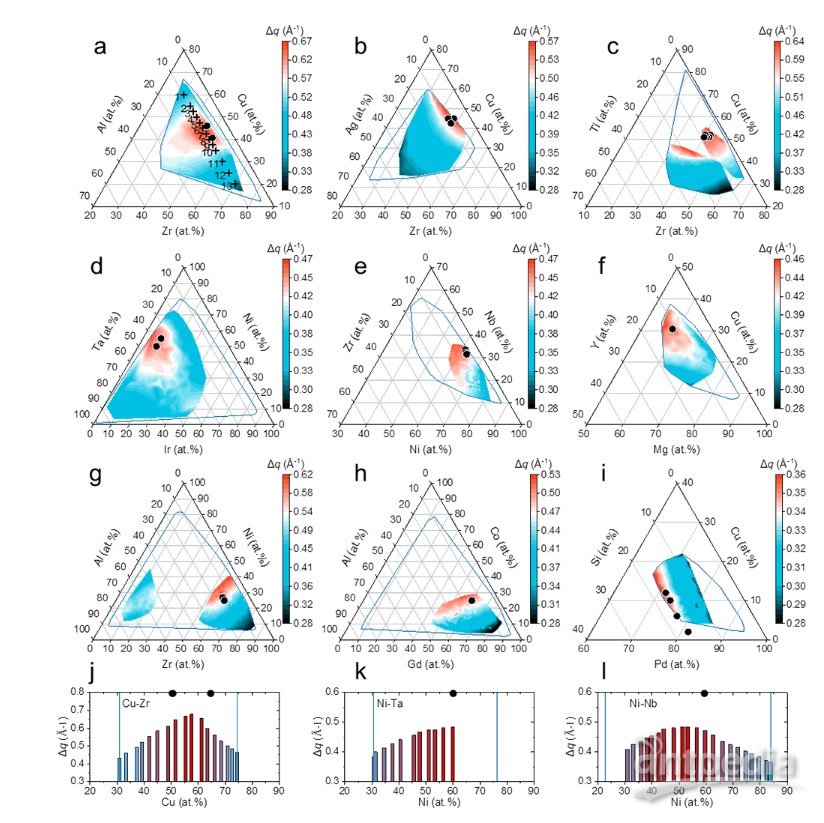
The research team and its collaborators analyzed the X-ray diffraction (XRD) patterns of more than 5700 alloys and their relationship with the amorphous forming ability, and found that the amorphous forming ability of the alloys was related to the peak width of the first XRD peak( Δ q) There is a clear correlation. utilize Δ Q-gfa criterion, the research team found new amorphous alloy materials in Zr Cu Cr and IR co TA alloy systems, and verified the correctness of this criterion. On this basis, the research team further explored Δ The theoretical mechanism of q-gfa criterion is found to be wide Δ The overall disorder degree of alloy structure reflected by Q is related to the occurrence of several specific clusters. The more kinds of cluster configurations, the more conducive it is to achieve close to crystal density in amorphous structure. Because the atomic spacing of each cluster is different, the result is Δ Q reflects the difference.
The above research results change the traditional research conclusion that the more single specific clusters appear, the stronger the amorphous forming ability, and give a new direction for understanding the formation mechanism of amorphous alloys. Δ The proposal of q-gfa criterion also provides a convenient, practical and efficient new criterion for exploring new amorphous alloy materials, which can greatly improve the efficiency of developing new amorphous alloy materials. Compared with the traditional "trial and error method", the efficiency is increased by more than 200 times.