
Ring opening conversion of aromatic derivatives
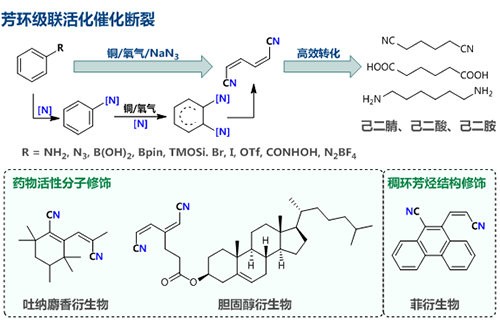
Carbon carbon bond is the most basic structure to build most organic molecular skeletons. Its selective fracture reaction can realize the direct modification and transformation of organic molecular skeletons. It is also considered as a new generation of material transformation. It has important potential application value in petroleum cracking, coal liquefaction, polymer and biomass degradation. Since Faraday discovered benzene in 1825, the substitution reaction of aromatic compounds has been fully developed. However, due to its conjugated and stable ring structure, the breaking of carbon carbon bond and ring opening into chain aliphatic hydrocarbons is still a major challenge in this field.
State Key Laboratory of natural drugs and Biomimetic Drugs (Peking University) Professor Jiao Ning's research team cooperated with K. Houk, a theoretical computational chemist at the University of California, Los Angeles, and proposed a cascade activation strategy through biomimetic design, which solved the major scientific problem of selective catalytic ring opening conversion of inert aromatic compounds for the first time, developed a new catalytic inert carbon carbon bond activation mode, and realized a variety of simple and easily available methods such as aniline Conversion of aromatic derivatives to alkenylnitrile. This study has realized the efficient transformation of a series of aromatic derivatives from selective ring breaking to high value-added six carbon synthons, which is expected to provide new ideas for the activation of inert carbon bonds, provide new ways for the high-value transformation of simple aromatic hydrocarbons from crude oil and coal, and also provide new methods for the degradation and utilization of biological substances and the modification of functional material molecules and drug active molecules. Relevant achievements were recently published in the international academic journal Nature.