
Macro separation of single chiral carbon nanotubes
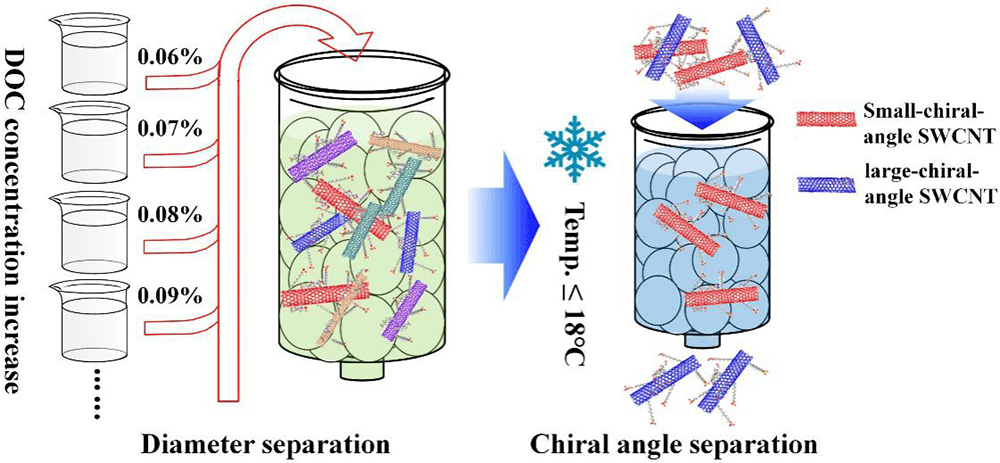
Single wall carbon nanotube (SWCNT) is a one-dimensional tubular nano material formed by crimping single-layer graphene. Due to the existence of quantum confinement effect, the radial motion of electrons in single-walled carbon nanotubes is limited and often shows novel physical properties. However, At present, the prepared carbon nanotubes usually have different diameters and crimping methods (commonly known as "chiral angle") )And present corresponding different physical and chemical properties. How to accurately identify and screen different chiral carbon nanotubes with small differences in atomic scale structure and realize the large-scale preparation of single chiral carbon nanotubes is not only the premise and foundation to reveal their novel physical properties and further develop their applications, but also a worldwide technical problem.
Supported by the key program of the key research and development program of China, "key scientific issues in transformational technology", the Liu Huaping team of the Institute of physics, Chinese Academy of Sciences / Beijing Condensed Matter Physics National Research Center developed the high-precision gel chromatography technology based on the previous study on the separation and preparation of carbon nanotubes. The macro preparation bottleneck of near serrated single chiral carbon nanotubes with small chiral angle was broken through, and 11 kinds of single chiral carbon nanotubes with chiral angle less than 20 ° were separated and prepared, of which the separation yield of 7 kinds of near serrated single chiral carbon nanotubes reached the order of Mg. The separated carbon nanotubes can realize single photon energy emission in communication band through covalent modification, which shows a good application prospect in single photon emission devices. This achievement further improves China's ability in the preparation of single chiral carbon nanotubes, and also provides a material basis for the systematic detection and regulation of the physical properties of carbon nanotubes and their applications in the fields of information electronics, optoelectronics, biological imaging and so on.